
Story of When World War II Came to Aruba
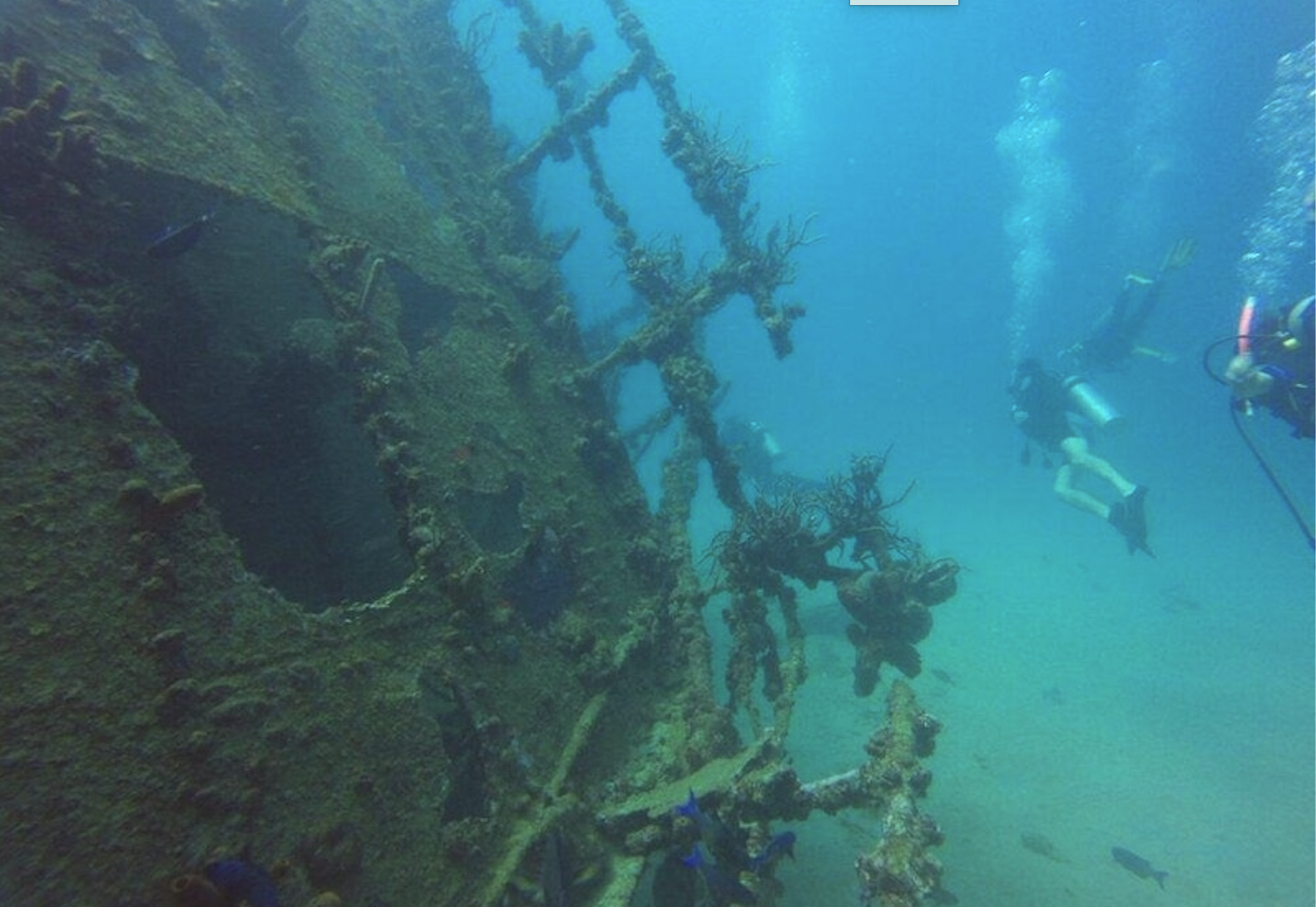
Photo: Trip Advisor
As we drop below the surface of Malmok Bay, parrotfish and a sea turtle swim into view. Here in the waters just west of Aruba’s northern tip, the sun illuminates everything in kaleidoscopic clarity. Yet the most curious thing on the seafloor isn’t the tube sponges or the gorgeous brain coral, but the noble-looking wreck of the 400-foot German ship Antilla. It’s one of the largest shipwrecks in the Caribbean and also one of the most accessible in the world, as it’s right along the coast, visited by all the snorkel tours and just 60 feet below the surface. Its bones tell the story of when World War II came to these blissful seas.
Though many World War II maps and textbooks understandably put Europe at the center, many world leaders in the 1930s and ’40s also had their eyes on the Caribbean, particularly on its oil. Companies were constantly moving oil in shallow-draft tankers from Venezuela, a petro titan, over to Curaçao and Aruba, which then held some of the world’s largest and most important refineries. In 1940, Dutch officials had even drawn up plans to place both of these islands, then part of the Dutch Antilles, under the protectorate of the United States, should the Netherlands be drawn into war.
Tour guides and tourists in Aruba alike often neglect this war history, distracted by mixed drinks, white sand beaches and deceptively placid turquoise waters. “A lot of time we focus on what we can see on land,” says Raymundo Dijkhoff, a native Aruban archaeologist and the head of the research and collections department at the National Archaeological Museum of Aruba. “We forget we have a rich cultural history … underwater.”
Some of that history is getting modest, and quite belated, public notice on Aruba. The Ministry of Infrastructure is attempting to tell a more accurate story than some of the guides, who claim that faced with Dutch marines wanting to forcibly board the Antilla, its crew scuttled the ship by heating up the boilers and creating an explosion that would snap it in half. Many Aruba dive websites bait the internet with this same story. But this oft-repeated narrative is largely false. The government office is overseeing the completion of an open-air memorial, approved in 2024, near San Nicolas on the southern tip of the island, which will tell the explosive true tale of how World War II began in the Caribbean.
Before coming to rest on its port side on the floor of Malmok Bay, the 4,400-ton German freighter Antilla had set off on its maiden voyage from Hamburg on the spring equinox of 1939. For the next few months, the merchant ship sailed between the Caribbean, Texas and Colombia transporting commercial loads such as sulphur, until one August day, when the Antilla’s Captain Ferdinand Schmidt heard the word “Essberger” over the radio—a signal for the captain to open sealed orders. Those orders directed him to leave main shipping lanes immediately—an indication that Germany was about to declare war in Europe, so it needed to bring home ships flying under its flag to prevent their seizure in foreign ports or international waters. When a second “Essberger” came through, Schmidt knew he was being ordered to return to Germany.
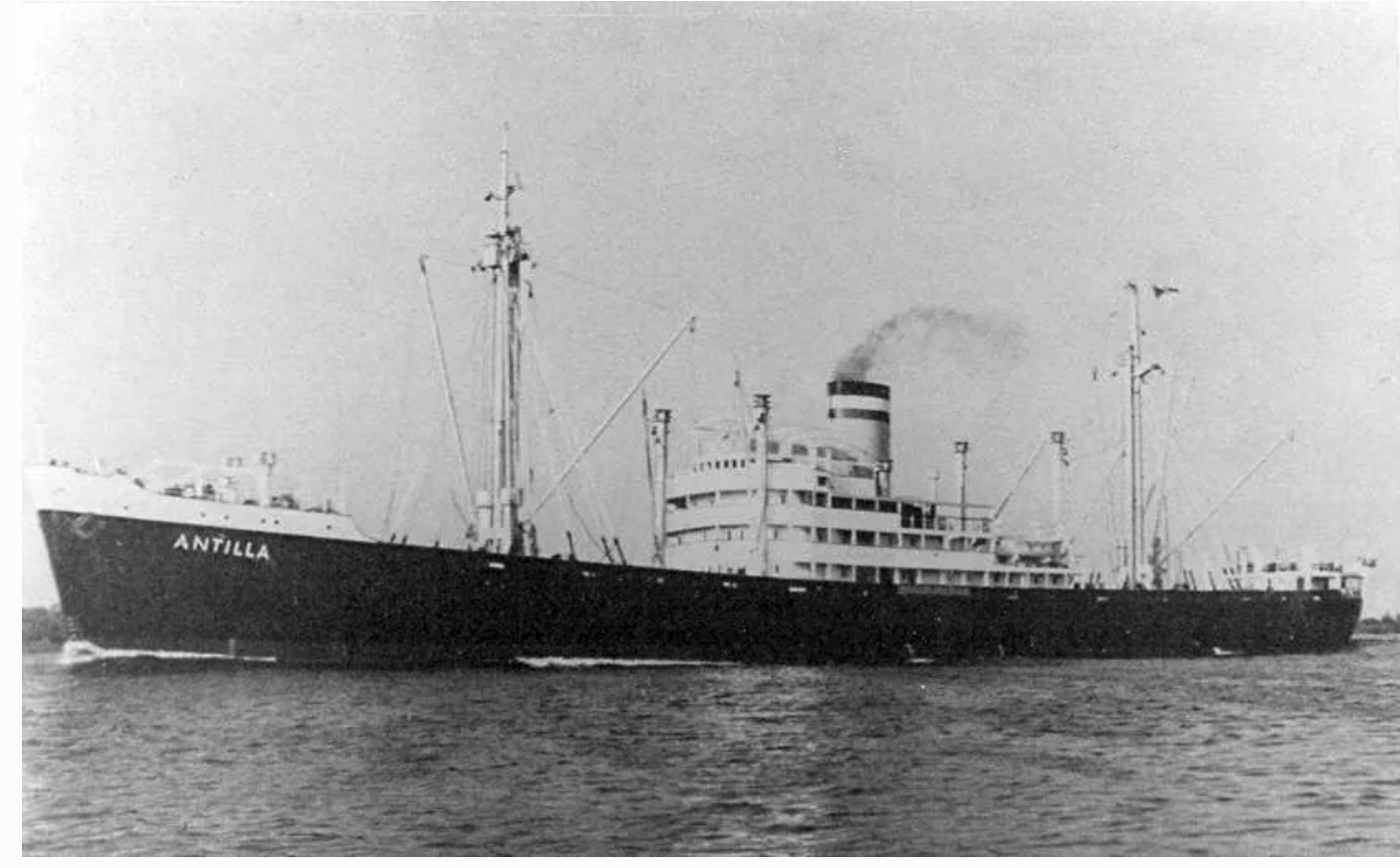
But the Antilla wasn’t fast enough to reach the open Atlantic in time. By August 31, new orders forced Schmidt to seek refuge in neutral ports. The very next day, Germany invaded Poland. World War II had begun. Outside Dutch Antilles waters, a blockade of French and British warships had formed. But the Dutch were still officially neutral, making the islands of Curaçao and Aruba an attractive haven. While most German ships in the Dutch Antilles docked in Curaçao, Schmidt opted for Aruba.
After being stuck in the Caribbean for half a year, on the last day of February 1940, Schmidt and two other German boat captains attempted to break the blockade. Dutch submarines caught up to the fleeing boats that night. One German ship, the Troja, failed to sneak past. The crew were arrested, but not before setting their ship on fire, sinking it. A similar fate met the German freighter Heidelberg and its crew. The Antilla, driven back to port, sat off the shores of Aruba for two and a half more months.
Then, Germany invaded the Netherlands. In retaliation for the invasion, the governor of the Dutch colonies of Aruba, Bonaire and Curaçao instituted martial law “to forestall ‘Trojan Horse’ activities” by agents of the Axis powers, making the islands the first place in the Americas to declare a state of war. More than 200 innocent German, Austrian and Italian nationals, some of whom happened to be Jews fleeing Europe, were rounded up and placed in schools serving as temporary internment camps. The Jews might have been surprised to find themselves confined alongside Nazi sympathizers and German crew members who’d set their own boats on fire in Curaçao’s main harbor.
On May 10, at 3:10 a.m., Dutch marines attempted to board the Antilla. But Schmidt refused them, buying his men vital time to scuttle the ship. The crucial delay allowed the Antilla’s crew to open the seacocks and flood the ship; they also set fires to prevent the Dutch from interfering with its sinking. Eventually, the Dutch arrested 35 crew members, who joined 185 other German merchant marines in the prisoner of war camp. The Antilla sank a few hours later. Schmidt and his crew remained imprisoned, first in schoolhouses on Bonaire and later on the island of Jamaica, where they remained until the end of the war in 1945.
Meanwhile, the war in the Caribbean raged on. A fleet of German U-boats laid siege to Aruba in what became known as Operation Neuland. On February 16, 1942, at 1:30 a.m., the first explosion rocked the island—likely from a missile strike on a refinery. Automobiles racing toward safety along the island roads turned off their headlights to avoid being targeted; Aruban men climbed poles to cut the electricity and lights. While the islanders plunged Aruba into tactical darkness, the U-boats lit up the seas.
“In all my life, I have never seen such a terrible sight, such a horrible inferno,” one witness recounted to the Chicago Daily News Foreign Service the next day. “The ever-present high wind helped to carry the flames over the ocean—a literal river of fire.” The British ship Oranjestad was ablaze in the harbor. Men burned to death. Then German submarines torpedoed the British tanker Pedernales and fired at the Standard Oil refinery. Though none of the U-boats made a direct hit on the refineries, two days later, an 18-foot-long dud torpedo was discovered on the shoreline nearby. When several Dutch officers arrived to detonate the bomb, it exploded prematurely, killing four of them.
Aruban author Clyde Harms, who was 92 when he spoke with me on the phone in 2024, attended school in Horse Bay, near the port of Oranjestad and one of the refineries. Harms recalled that he was terrified, convinced “that the Nazis would invade Aruba.” He was 10 years old in 1942 and described watching a German submarine surface a few hundred yards from his school.
Historian Renwick Heronimo laments that World War II in Aruba is hardly remembered, even though, he says, “it remains one of the largest calamities” in the island’s history.
Most visitors have little way of knowing that World War II ever came to this self-proclaimed “happy island” and the Caribbean Sea. But the region is the graveyard to more than 300 torpedoed and scuttled ships from the war years. “Marine archaeology in Aruba is in its baby-time,” Dijkhoff admits, explaining that there “never has been any archaeological documentation” of the Antilla. But the Aruban government’s efforts to bring attention to this overlooked history through the open-air memorial and its informational placards will allow visitors to learn the truth—even if the snorkel tours sometimes present misinformation—about the shipwrecks that reveal the consequences of when World War II came to the Caribbean.
Source: smithsonianmag.com. Noah Lederman