
Pleasure Boat That May Have Once Made Luxurious Voyages Along the Nile
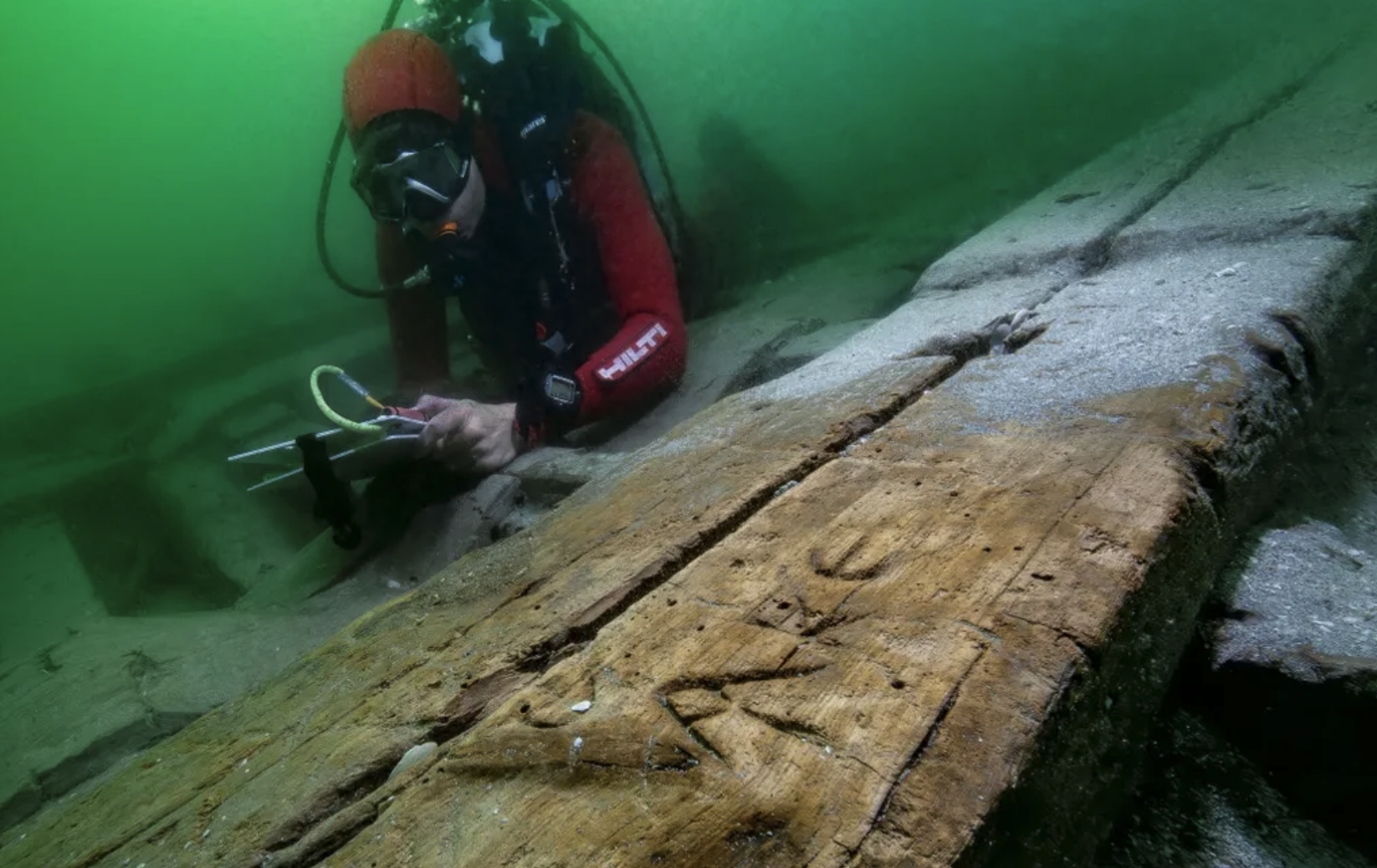
Researchers think the Greek graffiti found on the boat dates to the first century C.E. Christoph Gerigk Franck Goddio /Hiliti Foundation
Unearthed off the coast of Alexandria, the vessel may have once measured 115 feet long. Experts think it would have held a “luxuriously decorated cabin” and a team of 20 rowers
Beneath five feet of sediment on the Mediterranean seafloor, archaeologists have discovered the remains of an ancient Egyptian pleasure boat known as a thalamegos. It sank nearly 2,000 years ago in the Portus Magnus of Alexandria, Egypt, a great harbor swallowed by the rising sea after a series of earthquakes.
Led by Franck Goddio, a maritime archaeologist at the University of Oxford, researchers from the European Institute for Underwater Archaeology (IEASM) found the vessel’s sunken timbers near the now-underwater island of Antirhodos. The preserved frame is about 92 feet long, but researchers estimate the actual boat was 115 feet long and 23 feet wide, according to a statement from IEASM.
“It’s extremely exciting because it’s the first time ever that such a boat has been discovered in Egypt,” Goddio tells the Guardian’s Dalya Alberge. “Those boats were mentioned by different ancient authors, like Strabo, and they were also represented in some iconography—for example in the Palestrina mosaic, where you see such a boat of a much smaller size with noblemen hunting hippopotamuses. But [an actual boat] has never been discovered before.”
Strabo, an ancient Greek geographer and historian, observed pleasure boats in Alexandria during the first century B.C.E. He wrote that the “luxuriously fitted out” vessels were used by royals for festivals and excursions, per the Guardian. Around the same time, craftspeople in Italy constructed what’s now known as the Palestrina mosaic, an intricate tile floor depicting boats on the Nile river.
Goddio tells the Guardian that he initially thought the sunken timbers came from two different ships “because the construction type was so strange.” Found at a depth of about 23 feet, the vessel had a flat-bottomed bow and a rounded stern. Goddio adds that this design made the boat “able to navigate in very shallow water.”

Researchers were initially confused by the boat's odd structure. Christoph Gerigk © Franck Goddio / Hilti Foundation
The boat would have held 20 rowers and featured a central pavilion, which would likely have been “richly” decorated and “full of luxury,” Goddio tells Nil Köksal of CBC Radio’s “As It Happens.” It was made for traveling along the Nile River rather than sailing on the ocean.

The Palestrina mosaic, also known as the Nile mosaic of Palestrina, depicts scenes of the river. Public domain via Wikimedia Commons
Caroline Arbuckle MacLeod, an Egyptologist at the University of Saskatchewan, tells “As It Happens” that ancient Egypt’s pleasure barges were like modern yachts. MacLeod, who wasn’t involved in the discovery, says kings used them to journey up and down the river, “similar to what you might do now on one of the sort of dinner yachts or cruises.” “When we think about sort of the highway of Egypt, it’s actually the Nile,” MacLeod adds. “It would have been full of different types of vessels for people moving back and forth, visiting friends, carrying their goods to be traded, journeying back and forth for business purposes, and then of course also for these types of pleasure cruises.”
In the center of the boat, researchers found graffiti written in Greek. They haven’t yet deciphered the text, which dates to the early first century C.E., per the statement.
While the recently discovered vessel may have been a royal’s pleasure boat, Goddio explains in the statement that there’s another possibility. The boat was found near the Temple of Isis, an ancient Egyptian goddess, which was located on Antirhodos. Goddio is also excavating the religious sanctuary, which was destroyed in 50 C.E., and he thinks the boat could have sunk at around the same time.
“In this case, in the middle of that boat, instead of having a pavilion, you will have a small temple dedicated to the goddess Isis,” Goddio tells “As It Happens.”

A map of the ancient remains of the Portus Magnus, with yellow indicating sunken and destroyed structures and coastline Christoph Gerigk © Franck Goddio / Hilti Foundation
The investigation into the discovery is still in its early stages, but it will be “a fascinating journey into life, religion, luxury and pleasure on the waterways of early Roman Egypt,” per the statement. The latest scientific results from IEASM’s ongoing excavations of the temple were recently published by the Oxford Center for Maritime Archaeology.
For now, based on the recommendation of UNESCO, the researchers are leaving the sunken boat in place on the seafloor. Goddio and his team reburied the frame in sediment to ensure its preservation.
“It was there for 2,000 years,” Goddio tells “As It Happens.” “It can stay still a few centuries in peace.”
Source: smithsonianmag.com. Sonja Anderson