
World’s largest cog found off Copenhagen

Maritime archaeologists in Denmark have revealed the remains of what is now considered the world’s largest known medieval cog, uncovered during marine construction work off Amager, near Copenhagen.
Named Svælget 2 after the shipping channel just outside Copenhagen where it was found, the ship dates to the early 15th century and offers rare insight into the scale, ambition, and technical sophistication of northern European seafaring during the Middle Ages.
The wreck was located in 2021 during excavations related to Lynetteholm, an artificial peninsula currently under construction at the entrance to Copenhagen harbour, Denmark, which will become a new urban district and act as a storm surge barrier.
The find was investigated and analysed by researchers from the Viking Ship Museum, who concluded that the vessel represents an unprecedented example of the cog type—a robust, clinker-built cargo ship that dominated trade in the Baltic and North Seas for centuries.
Super ship
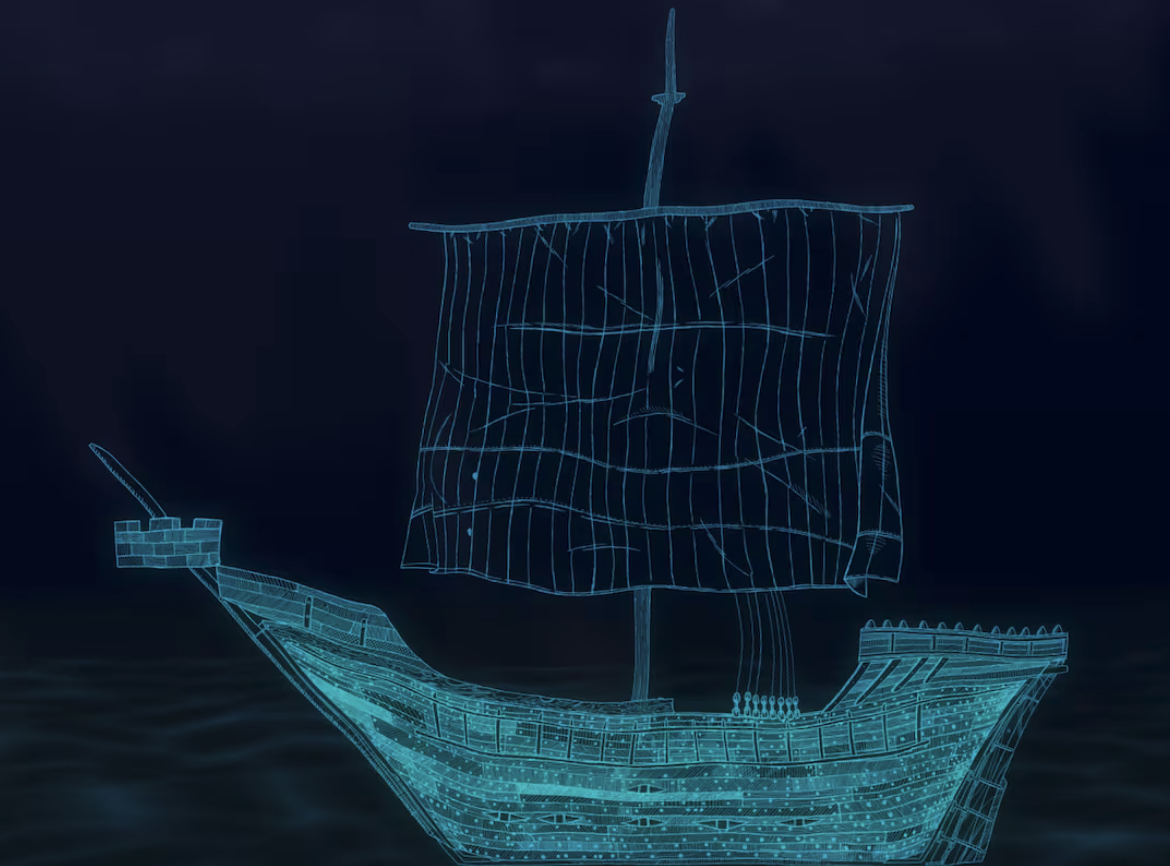
Dendrochronological analysis of the timbers dates the ship to around 1410 with the oak likely sourced from the southern Baltic region. At more than 30 metres in length and approximately 10 metres wide, the cog found off Amager significantly exceeds the dimensions of previously known cogs, earning its description as a medieval “super ship”.
It represents one of the most advanced vessel types of its time. Cogs were the backbone of northern European commerce, capable of carrying large cargoes of grain, timber and other bulk goods. The sheer size of the vessel suggests it played a major role in long-distance trade networks linked to the Hanseatic world, connecting ports across Scandinavia, Germany and beyond.
Exceptional preservation
The wreck was found in fragments, but otherwise exceptionally well preserved in seabed sediments. It was excavated at a depth of 13 metres, where it has been shielded from the forces that normally destroy ships near the coast. A detailed study of the surviving structure reveals a flat bottom, high sides, massive hull planking—features designed to maximise cargo capacity while maintaining stability in shallow harbours and coastal waters.
Cog castles
A major significance of the find is that it provides the first secure archaeological evidence for the bow and stern castles characteristic of medieval cogs. The remains include substantial elements of a timber-built stern castle, with a covered deck that offered the crew protection from the elements, representing a clear advance over the open-deck designs of Viking Age ships.
While these timber-built structures are well known from historical illustrations, they have rarely survived archaeologically, as most wrecks have only the lower hull preserved. Maritime archaeologist Otto Uldum notes that although “we have plenty of drawings of castles, they have never been found,” Svælget 2 changes that.
Life on board
Another notable discovery was the ship’s brick-built galley, the earliest example identified from medieval Danish waters. Constructed from around 200 bricks and 15 tiles, the galley allowed cooking over an open fire—an arrangement previously unknown on ships of this period in the region. Archaeologists recovered bronze cooking pots, ceramic bowls and remains of fish and meat from the area, along with finely cut wooden sticks that may relate to stockfish preparation.
This points to a higher level of comfort and organisation on board, enabling sailors to eat hot meals comparable to those ashore rather than relying solely on dried provisions, Otto Uldum notes. Together with finds such as painted wooden dishes, shoes, combs and rosary beads, the galley and associated objects provide a rare and vivid insight into everyday life at sea, showing how crew members brought familiar routines and personal belongings on long voyages.
Ongoing research
Further study will focus on refining the reconstruction, understanding the ship’s operational life and placing it within broader patterns of medieval trade. One of the key questions researchers continue to examine is what Svælget 2 was carrying at the time it sank. So far, no identifiable cargo has been recovered, with all finds attributable to crew possessions or standard ship’s equipment.
Otto Uldum notes that “we have not found any trace of the cargo. There is nothing among the many finds that cannot be explained as personal items or ship’s gear.” He explains that the vessel’s open hold would have allowed barrels of salt, bundles of cloth or timber to float free during the sinking. At the same time, the absence of ballast indicates that the ship was likely heavily laden with trade goods. Despite the missing cargo, the evidence leaves little doubt that Svælget 2 was a merchant vessel, with no indications of any military function.
Source: xray-mag.com. Images Credit: Viking Ship Museum