
Anemoi and partners win DNV approval in principle for rotor sail integration on MR tankers
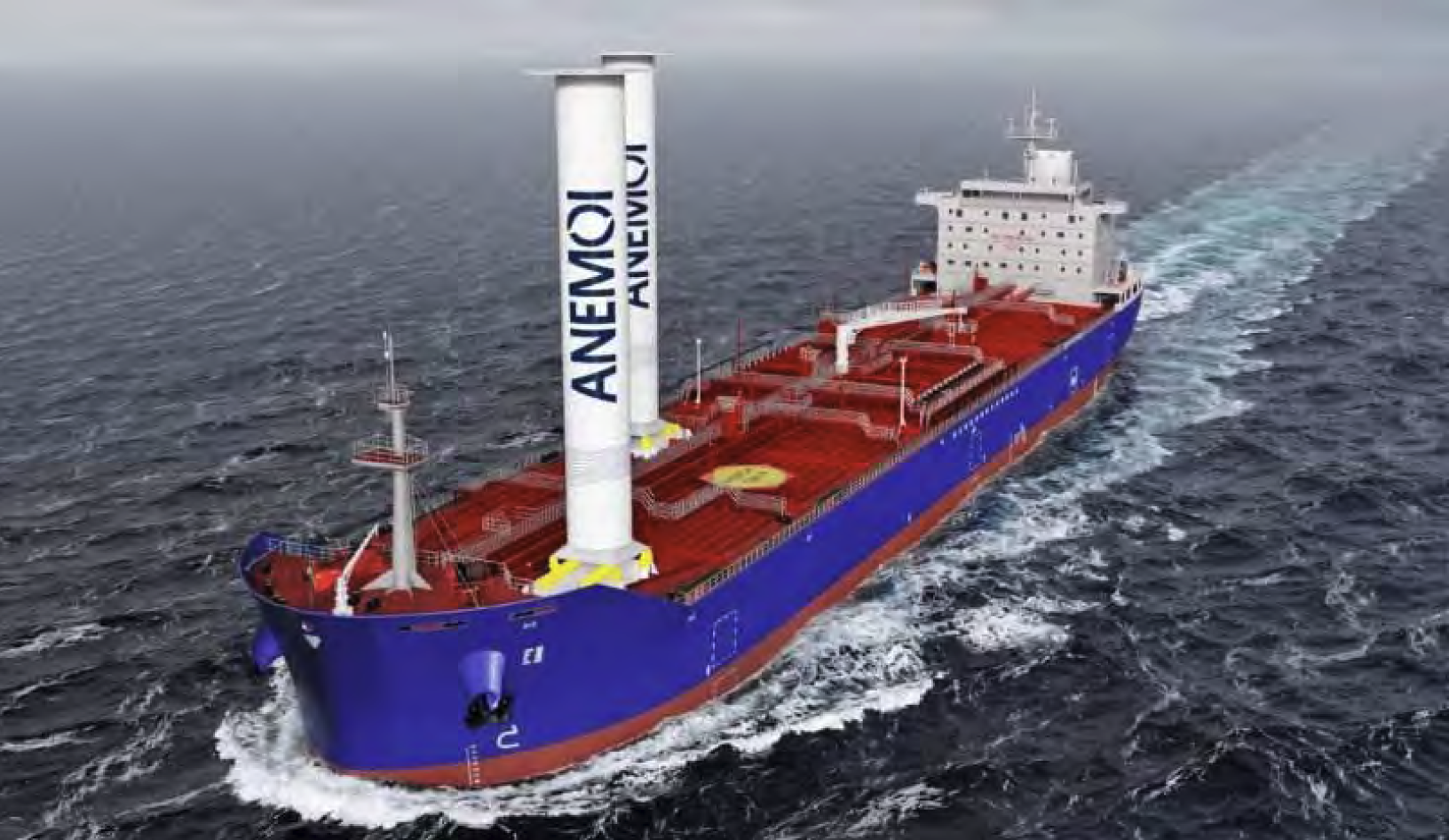
Anemoi Marine Technologies has concluded a joint development project (JDP) with Guangzhou Shipyard International (GSI), tanker operator Hafnia and classification society DNV that integrates folding, explosion-rated rotor sails into the design of a medium-range (MR) tanker, with DNV issuing an approval in principle (AiP) for the concept.
The project, announced at the Posidonia 2026 exhibition in Athens, which ran from 1-5 June, centres on two of Anemoi's 5 x 35 m folding rotor sails rated for use in hazardous areas (EX-rated) — a requirement for equipment deployed on the decks of product tankers, where flammable cargo vapours can be present.
Working with GSI, Anemoi developed a lightweight deck seat for the units that, according to the company, does not require underdeck structural strengthening while still allowing inspection and long-term maintenance. The partners addressed technical, structural, operational and regulatory demands specific to the MR tanker segment, including constraints around deck space, cargo operations and safety.DNV reviewed the design package, including the treatment of the rotor sails within the IMO's Energy Efficiency Design Index (EEDI) and Energy Efficiency Existing Ship Index (EEXI) framework, before issuing the AiP. An AiP is an independent assessment of a concept within a defined framework of requirements, confirming the feasibility of a design and verifying that no significant technical barriers exist to its implementation.The project also demonstrated what the partners describe as potential benefits to the vessel's energy efficiency performance, though specific figures were not disclosed.
Nick Contopoulos, Chief Production and Partnerships Officer at Anemoi, said: "Completing this project is a significant step for wind-assisted propulsion in the tanker sector. Demonstrating that our EX-rated rotor sail can be integrated efficiently, safely and with minimal structural impact on MR tankers gives owners a clear, verified pathway to adoption. We are grateful to all partners for the rigour and commitment they have brought to this work."
Jesper Kristiansen, General Manager Technical at Hafnia, said: "Identifying practical, scalable efficiency measures for the MR tanker segment is a priority for Hafnia as we navigate increasing energy efficiency and emissions reduction demands from both charterers and regulators. The work undertaken with Anemoi, GSI and DNV gives us a credible technical foundation from which to assess deployment of wind-assisted propulsion across this fleet."Huang Jun, Deputy Chief Engineer at GSI, said: "This project not only deepens industry understanding around wind-assisted propulsion integration but also solves very practical issues to deploying solutions on MR tankers. The result is that we are now in a position to offer rotor sail-ready MR tanker designs to owners worldwide."
Aakash Dua, Regional Business Development Manager at DNV, said: "The technical challenges of integrating new on-deck efficiency solutions for MR tankers make having an independent verification of new designs essential. At DNV, we are continually working to have our WAPS rules and guidelines evolve as innovations hit the market, building confidence and letting owners take advantage of new solutions. Working together with GSI, Anemoi and Hafnia, this AiP means we have a new technical reference point for WAPS in this important ship segment."
Anemoi, incorporated in 2015 and based in the UK, designs and installs Flettner rotor sails on large commercial vessels. The company states that each rotor sail saves approximately one tonne of fuel per day and around three tonnes of CO₂ emissions.
Source: bunkerindex.