
Singapore Cites Fatigue, Manning and Safety Culture in Fatal 2024 Accident
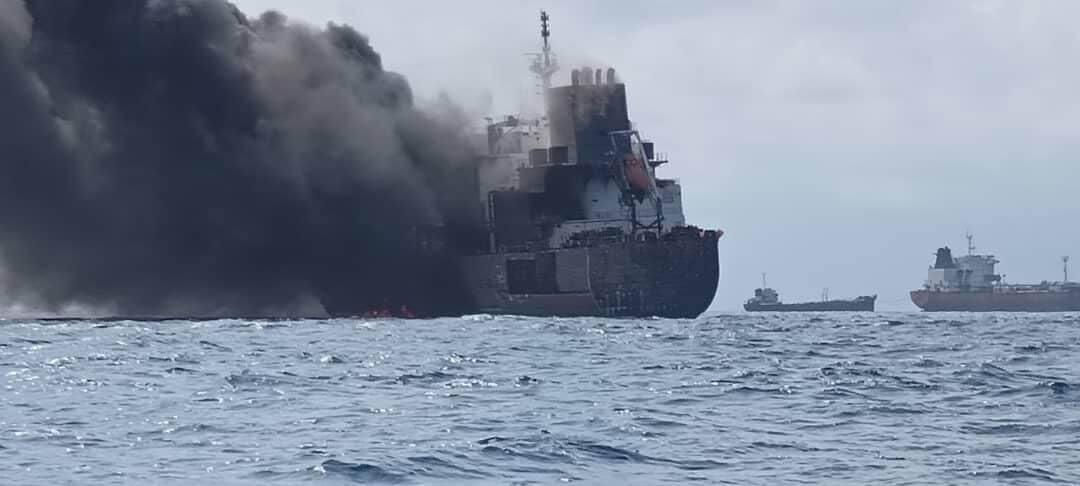
Photo: Maritime Malaysia
The Transport Safety Investigation Bureau of Singapore issued its final report on the July 2024 incident in which a Hafnia oil tanker hit an anchored Chinese-owned shadow fleet tanker in the South China Sea. The catastrophic allision of the fully-laden vessel moving at 14 knots with the empty tanker at anchor caused a massive fire that killed one person, injured several crew members of the anchored vessel, and severely damaged the two ships.
The report, which was issued at the end of December 2025, highlights that safety rules and company regulations were not being properly followed. The ships were in a very busy traffic area, and the report finds that both crews could have taken additional actions to prevent the allision.
The Hafnia Nile, which was registered in Singapore, was underway, having departed Singapore after a call for fueling and a crew change. The report highlights that it had been a busy port call, with the ship also undergoing inspections during its stay. The master of the vessel later told investigators it was customary for the Chief Mate not to take the first watch after departure because of the level of fatigue from the duties during extended port stays.
The Second Mate was leading the watch after the departure. The report, however, finds he had just joined the ship traveling from Colombo, Sri Lanka, with a transit through Kuala Lumpur. He reported having had just two hours of rest in a 38.5-hour period, as well as the strains of joining the ship and involvement in port activities. When he had finally gone for a rest, it was interrupted by an unannounced fire alarm test. The investigation concludes the Second Mate was likely tired from overnight travel, workload from joining the ship, and disrupted rest.
Despite transiting a high-traffic region, the Second Mate had left the bridge to prepare two reports. He was in the chartroom, which was separated by a curtain from the wheelhouse. The report concludes that the paperwork was non-critical and could have been completed the following day.
An Able Seafarer was left alone in the wheelhouse. During the departure, the master had been on the bridge along with a pilot and an ordinary seaman. The seaman was to be the lookout but had left to restring the pilot’s ladder. He had ultimately been relieved, and the master had stayed after the pilot’s departure until he was satisfied the vessel was in the traffic lane. He reviewed safety management and the navigation before leaving the Second Mate, who was the officer of the watch, alone on the bridge with the AB.
In command of the tanker, the Second Mate had made multiple changes in course and speed to deal with traffic before leaving the bridge at about 0540. He had returned to the bridge to make some further course adjustments. They had first spotted the anchored tanker, Ceres I, at a distance of over 6 miles and assumed there was little danger. The shadow fleet tanker had also identified the Hafnia Nile as approaching. As the distance between the vessels narrowed, another ship underway complicated the passage, but the report concludes that the Hafnia Nile and Ceres I would pass at about 0.7 nautical miles as the Hafnia Nile attempted to thread between the two ships.
The Second Mate had returned to the bridge at 0601 and saw that the Ceres I was very close and switched to manual steering and applied hard right rudder. At 0602, the Hafnia Nile’s bow contacted the Ceres I’s port anchor chain, which became entangled with the Hafnia Nile’s port bilge keel and drew the ships closer. The Ceres I’s bulbous bow breached the Hafnia Nile’s shell plating near the Heavy Fuel Tank and one of the cargo tanks loaded with naphtha, causing the fires on both ships.
The investigation also found that the Hafnia Nile’s S-band radar alarms had been silenced. The X-band radar alarms had been deactivated. It notes that these violations had removed an important safeguard for earlier detection.
The report also cites the crew of the Ceres I for not taking more actions to attempt to contact the Hafnia Nile as it was approaching. They had used sound signals and the Aldis lamp, but received no response from the Hafnia Nile. The report highlights that the Ceres I crew, despite the escalating risk, never tried using VHF to warn the Hafnia Nile.
The report notes that Hafnia has, since the incident, undertaken measurements focused on improved bridge watchkeeping practices and fatigue management after the incident. It says that the company strengthened its bridge team coordination and watchkeeping standards. The company also took steps to reinforce adherence to the bridge manning levels prescribed in its Safety Management System.
The managers of the Ceres I, it reports, updated their management systems for the use of communications tools. They revised instructions about responding to developing or time-critical close-quarter situations.
Singapore notes that the role of the Transport Safety Investigation Bureau is not to assign blame, but to prevent future maritime incidents. It is not their role to assign liability. Singapore's Maritime and Port Authority, however, filed charges related to the fatal 2024 incident. The two individuals, one from India and one from Sri Lanka, who were the navigational officer and lookout aboard the Hafnia Nile, were being charged under the Merchant Shipping Act. The Second Mate was accused of failing to maintain situational awareness and making a full situational appraisal of the risks to navigation. He was also charged with failing to ensure a proper watch was maintained. The Able Seafarer was charged with navigating the vessel on his own without the officer of the watch and failing to alert the officer of the approaching danger. If convicted, they could each face up to two years in jail and a fine of up to approximately $39,000 each.
Source: maritime-executive.com